
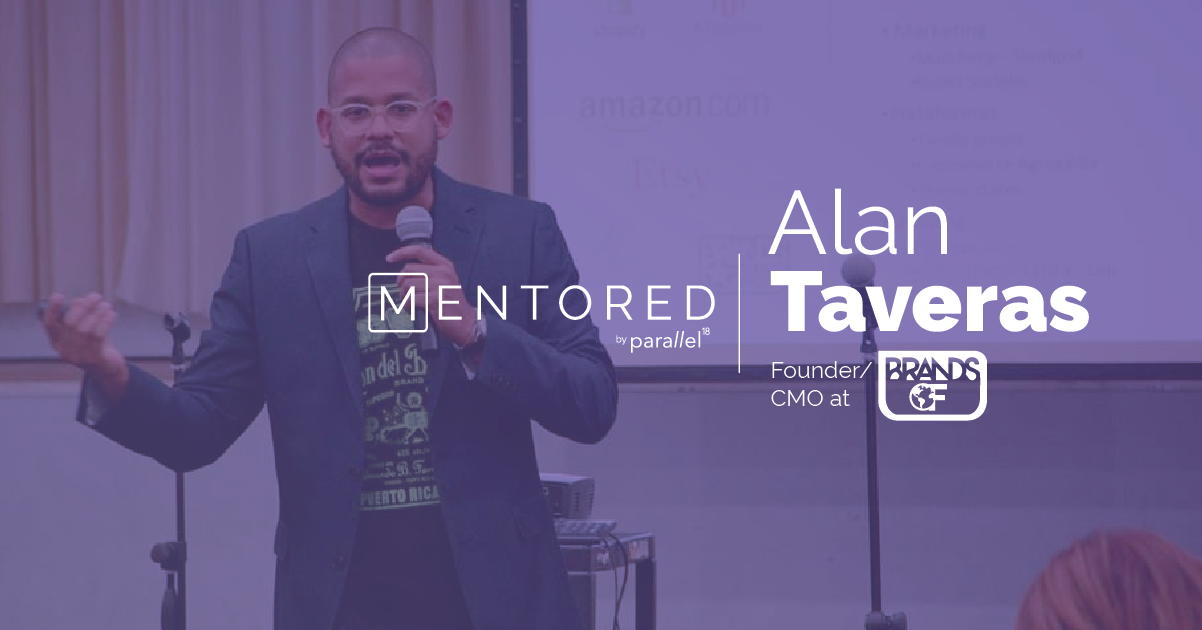
Mentored, episode 15, Alan Taveras
On his entrepreneurial beginnings
My very first entrepreneurial venture was during my last year of high school. I loved to party, but had no money, so I created a party promotion company. We did a party in Old San Juan, at Jara’s Cafe and we brought Yomo. Now, that was right after his success with “Dejale Caer To’ El Peso”. More than a thousand people made it. I was still a minor and my mom had to be at the door with me. I am an entrepreneur through and through. The only regular job I’ve held has been teaching at a college. I never been in the corporate world. I studied Advertising and did an MBA in Information Systems.
On Brands Of original concept
I did my masters in Buenos Aires, my brother in Boston. We felt the diaspora’s nostalgia. When we came back, we created a digital advertising agency and that’s when the bonds crisis took off. Everybody was leaving the island. And what most people saw as as negative, we saw it as an opportunity.
We began before parallel existed. There was Startup Weekend and Founders Institute, but the financing, the incubator did not exist. Initially, we were thinking about regional expansion, but the month we launched, we had a gut feeling and started buying domains for other countries. Then we noticed that the concept worked and was liked.
On market selection
I had the opportunity and privilege of studying with people from all over Latin America.
After Puerto Rico, we opened in Nicaragua and Dominican Republic. In Nicaragua there was no e-commerce, so we could be the first to deploy. Also, we barely had resources. And, since we are half Dominican, we knew we could handle both markets.
People always strategize, but the resources dictate what you can do. If right now you say, I want to go to Mexico and do not have the capital, you will fail. It’s the combination of resources and capital. And no one will give you money if you have no proven track. We are learning from each market, but having our corporate structure and sales has allowed us to raise the necessary capital to open in Mexico, for example.
On entering a new market
Our mantra is “buy local” and I cannot go into another market and ask that because I am not their local. So we do need a local face for that. We do need a corporate structure in each country because part of my pitch is that I’m bringing in money and that we are an economic development tool. But we don’t necessarily need a physical office, we use WeWork in Mexico. But each market has that corporate infrastructure we have already set up because everything falls under the same holding company.
On flexibility for your concept
We learned through our deploys in Nicaragua and Dominicana. The concept is replicated but the shipping process and how you work with the brands is very different. Mexico has a very strong logistics infrastructure in place. We never even touch the products. In Puerto Rico we handle everything and have a flat fee for the brands. In Mexico, that fee changes. The takeaway is that you cannot replicate exactly what work in another market because their idiosyncrasies and labor laws are different. Be flexible while keeping the same concept
On raising capital
My business is e-commerce, where I do not necessarily need the best IT person. This is a straight up customer acquisition and the capital is used to find more customers that spend more money. The rounds help making those plans easier. It cost a lot to create this corporate structure and had we not had this capital, we couldn’t have been able to deploy in Mexico, our most important market. It is a formula of opportunity and initial traction.
On the importance of creating your own path
My path won’t work for you, our path is uniquely ours. A startup is like a human in the sense that if you try to replicate, like saying “I want to be Steve Jobs” you won’t do that. You’re living a different time, have different connections.
What I did learn, and this was my best lesson this year, was patience. Our company has four years under its belt, many accomplishments and raised capital. But it’s trial, fuckup, lesson learned. Now everyone says that they have the perfect formula and I’m completely against that, because no one else can tell you what you startup needs to work. You have to find your own sweet spot.
On networking, net worth and new markets
If you’re opening in a new markets, you have to move. An employee, as well as they could work, will never work the same way a founder would. You need that motor.
You have to expose yourself to new things. If you’re not a technical founder, your job is 100% to find connections. You have to be the noisiest person in the world. Your network is your net worth, beyond the money.
On his biggest fuckup
I don’t think it was a fuckup, but during our first two years, I was focused in participating on everything: every event, every talk. But it steals your focus. I learned how to keep a balance. But I cannot pinpoint a fuckup, there have been campaigns that haven’t worked, spending too much money, but that’s not out of the ordinary.
On starting a tech business in Puerto Rico
If you’re not thinking big, beyond Puerto Rico, then you’re wasting the entrepreneurial ecosystem. I was speaking with another cofounder about the available funding and it’s give or take US $100K.
I like to keep it simple. Our company is for people feeling nostalgia. The problem you’re trying to solve should be a headache for thousands of people, like for example, an app to see where there are power outages in Puerto Rico.
On being in a international accelerator
Brushing shoulders with entrepreneurs all over the world is a huge, good, necessary slap to your ego. You can keep believing that you’re ok because you’re doing well in Puerto Rico, but the market is not just Puerto Rico, it’s the entire world.
On what makes a startup successful
That the team feels pride. That’s not necessarily attached to how much they’re paid. Personally, I think that you’re successful if you’re still working hard — or even harder- on your mission and I feel pretty successful.
His advice for budding entrepreneurs
We are where were because we dared to take risks, dream big and follow the plan.
This is a numbers game out of 10 proposals, you’ll get at least 8 nos. Just brush it off and keep moving. The worst that could happen is that you have to shut down and have to find a regular job. But I believe that my resume looks much cooler thanks to BrandsOf.
Recommendations
Books
Principles by Ray Dalio As your business grows, the decisions become more technical. You need to have your principles structured from the beginning, everything else is just numbers.
Alibaba The Inside Story Behind Jack and the Creation of the World’s Biggest Online Marketplace — you have to take a look at people in your industry
Podcast: Empresarios con Pablo Tirado
Playlist: Brands of Puerto Rico’s De Mi Finca a Tu Mesa